Division 07 barriers · Capital Region
Fluid-applied air and water barriers
Continuous weather membranes, sheathing joint prep and rough-opening transition flashing installed by the same crew putting cladding over the wall.
Call or text (518) 888-7938
Book spring work now. Winter assessments and estimates available.
Updated November 2026
Short answer
We install fluid-applied air and water barriers, sheathing joint treatment and rough-opening transition flashing on commercial and multifamily buildings across the Capital Region. Putting the weather barrier and the exterior cladding in one subcontract removes the trade gap at window bucks, shelf angles and parapets. Our own crews verify substrate readiness and wet-mil thickness before covering the wall.
Key facts
- Service area
- Albany, Schenectady, Troy, Saratoga Springs, Glens Falls and jobs within about two hours of Albany.
- Season
- EIFS and stucco finishes need about 40 °F and rising, with no freezing for 24 hours. In the Capital Region that means spring through late fall.
- Who does the work
- Our own crews, from The Dom Construction Group LLC.
- Insurance
- General liability, umbrella and workers' compensation insurance; certificates on request.
- Estimates
- Free. Start with 3–5 photos by text, or use the form.
- Reply
- We reply within one business day, Monday to Friday.
One crew for the weather barrier and the cladding over it
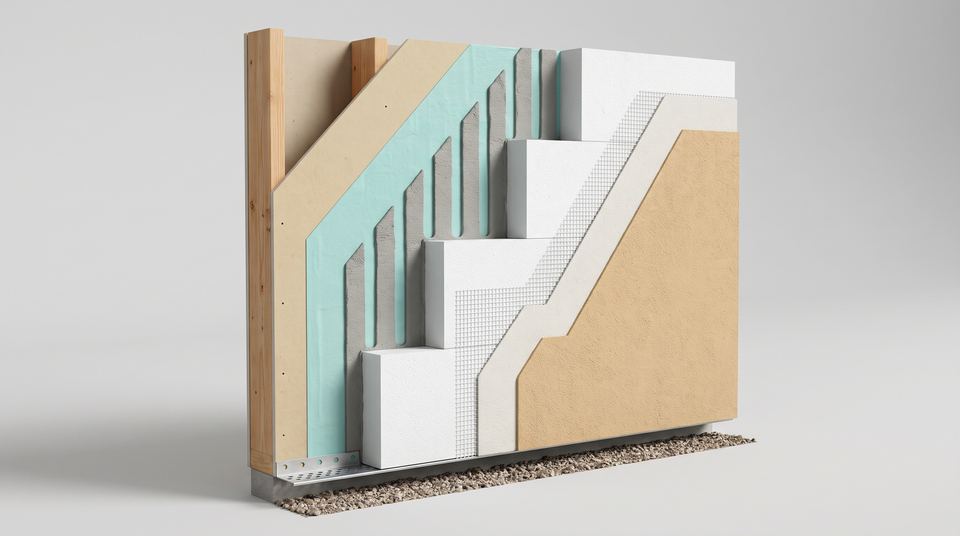
On commercial, institutional and multifamily buildings, the fluid-applied air and water barrier is the real line of defense behind the exterior veneer. Whether the outer finish is commercial drainage EIFS, ACM and plate panels, cement stucco, brick or stone veneer, bulk water that gets past the cladding has to hit a continuous, defect-free membrane and drain back outside.
When a general contractor splits Division 07 air barriers from the facade cladding subcontract, schedule friction follows. The barrier sub demobilizes before window bucks are ready, cladding anchors punch through the cured membrane without anyone claiming the patch, or the EIFS adhesive specified in Division 07 will not bond to a silicone-modified membrane chosen by another trade. Assigning the air and water barrier, rough-opening flashings and exterior cladding to 518 GC Exteriors puts substrate prep, membrane continuity and cladding attachment under one superintendent and one scope letter.
Substrate prep, seam treatment and rough openings
Roller- or spray-applying liquid membrane over open wall fields is the fast part of the scope; durability is won in the prep work before the pails open. Our own crews execute each preparatory step systematically:
- Substrate inspection: Checking exterior glass-mat gypsum sheathing for broken corners, fastener blow-throughs, gaps wider than manufacturer limits and damp or chalked facers, and verifying clean mortar joints on CMU backup walls.
- Sheathing seams and corners: Treating every board joint, inside corner and outside corner with compatible joint compound, reinforcing fabric mesh or liquid flashing detail coat before field application.
- Rough openings: Wrapping window, storefront, louver and door sills, jambs and heads with fluid-applied flashing or compatible self-adhered transition strips, turned into the rough opening and integrated cleanly with sill pan flashings.
- Penetrations and structural ties: Detailing around conduit sleeves, hose bibs, brick ties, canopy knife plates, relief angles and Z-girt standoffs so air leakage and water tracking stop at the sheathing plane.
Sequencing membranes with window bucks and roofing
Nothing ruins a facade water test faster than reverse-lapped transitions at windows or parapets. Before glazing installers set frames, we coordinate rough-opening wrap depths and sealant compatibility so the window perimeter seal bonds directly to the air barrier return—turning the window frame and wall membrane into one continuous air plane. At roof lines and parapet tops, we coordinate tie-ins with the roofing contractor's vapor retarder or parapet underlayment so wind uplift and blowing snow cannot push moisture behind the top edge of the wall membrane.
Mil-thickness checks and material compatibility
Fluid-applied vapor-permeable and vapor-retarding barriers only perform at their tested permeance and air-leakage ratings when applied to the manufacturer's specified wet-mil thickness. During installation, our crew checks wet film thickness with a notched mil gauge across both smooth gypsum sheathing and porous CMU block, back-rolling pinholes and holidays before the coat skins over.
Most fluid-applied coatings also require substrate and air temperatures of 40 °F and rising during application and cure, with dry surfaces free of frost. During preconstruction—see how to bid with us—we review your Division 07 specification alongside the cladding adhesive and waterproofing sealants to confirm full chemical compatibility, UV exposure limits before cladding cover-up, and cold-weather product options if your shell closes in late in the year.
AI-generated illustration
Air and water barrier questions
Do you install both vapor-permeable and non-permeable fluid-applied barriers?
Yes, depending on what the project's Division 07 specification and wall dew-point design require. Most framed Capital Region commercial assemblies specify vapor-permeable fluid-applied air and water barriers over exterior gypsum sheathing so framing cavities can dry outward, while certain high-humidity interiors or masonry assemblies specify vapor-retarding membranes. We follow the specified manufacturer's system components from seam filler through rough-opening flashing.
How do you verify proper membrane thickness across gypsum sheathing and CMU?
Dry film performance starts with wet-mil verification while the coating is going on the wall. Crew members check wet film thickness regularly with notched mil gauges, paying extra attention to porous CMU block, mortar tooling lines and textured glass-mat facers that drink up more material than smooth samples. Pinholes, holidays and thin spots are back-rolled immediately before curing.
Should the air barrier go on before or after commercial windows are installed?
Rough-opening sill, jamb and head transition membranes should go in before window or storefront frames are set so the frame sits over a continuous waterproofed sill pan and wrapped opening. After the glazing contractor sets and anchors the frames, interior air-seal rod and sealant—and any exterior perimeter tie-in strips—complete the airtight bridge between window frame and wall barrier.
How long can a fluid-applied air and water barrier stay exposed before cladding?
Exposure limits vary by product chemistry, typically ranging from a couple of months for standard acrylic or asphaltic emulsions up to six or twelve months for silicone- or silyl-terminated-polymer membranes. During submittal review we check your construction schedule against the specified product's UV exposure rating so elevations left open through winter will not require recoating before cladding installation.
What substrate problems hold up fluid-applied membrane installation?
Standing moisture or frost on sheathing, gaps between gypsum boards wider than a quarter inch, overdriven screws that crush the gypsum core, uncleaned mortar droppings on CMU, and chalky fiberglass facers left exposed too long all impair membrane adhesion. Walking the exterior framing with the superintendent a week before mobilization catches those items while framing crews are still nearby.
Get a quote on air and water barriers
Send Division 07 specs and exterior elevations to price the barrier standalone or bundled with cladding.
Cladding and sealant scopes over the barrier
- Commercial EIFS
Drainage EIFS adhered directly over compatible fluid-applied membranes.
- Aluminum panels
ACM and plate panel rainscreens over continuous barriers and insulation.
- Waterproofing
Window perimeter sealants, expansion joints and breathable wall coatings.
- Bid with us
How we review membrane and adhesive compatibility during estimating.
Need barrier and flashing pricing on an upcoming bid?
Book spring work now. Winter assessments and estimates available.